Disclaimer: LEGO Pokémon sets have not officially released at the time of writing. My writing is based on revealed specifications and official images.
The End of MEGA and the Beginning of LEGO Pokémon Sets
LEGO Pokémon sets are officially here, and with their arrival comes the end of a long-running era for MEGA-built Pokémon.
For many years, Pokémon building sets were produced by MEGA, a brand owned by Mattel. MEGA released a good amount of Pokemon sets , mostly medium to large display builds, and for a long time they were the only official option for Pokémon fans who wanted brick based Pokémon sets. All of that changed in January 2026.
LEGO has now officially secured the rights to produce Pokémon building sets through a new partnership with The Pokémon Company. As part of this transition, Mattel stopped producing MEGA Pokémon sets in December 2025, bringing a long-running partnership to a close.
This is not a case of LEGO and MEGA competing side by side. This is a handover. A look at a closing chapter and an opening one. A comparison between what MEGA achieved over many years, and what LEGO appears to be setting up based on what we know so far.
That shift makes it worth examining how LEGO Pokémon sets compare to what MEGA built before them. Yes, this comparison might feel early. LEGO has only revealed three Pokémon sets so far. But even with just those three, the design choices and pricing already point toward a clear direction. And for me, that direction feels uncomfortably close to the same problems MEGA faced, just at a much larger scale.
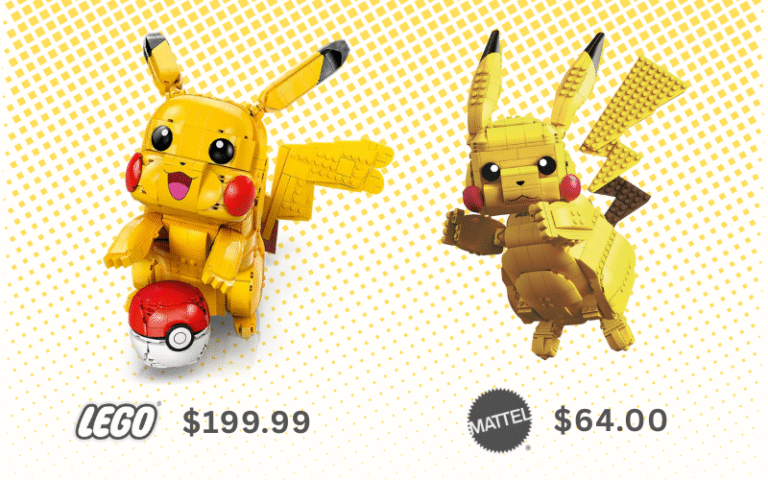
🟡 LEGO Pikachu vs MEGA Pikachu
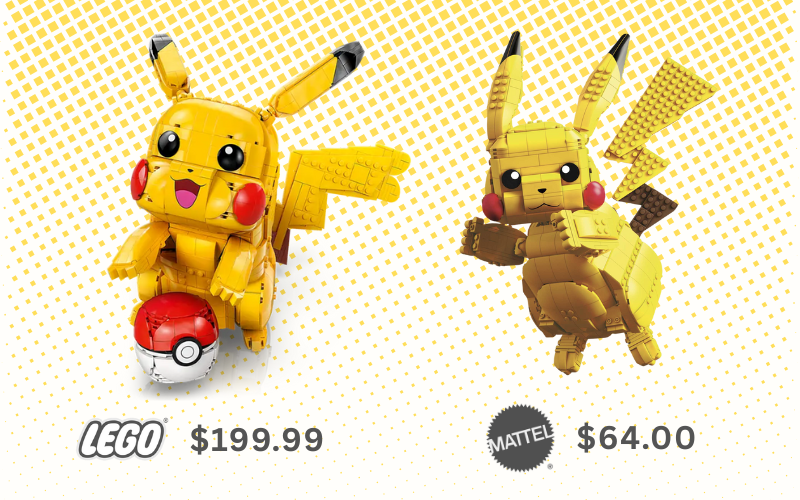
Pikachu is where LEGO’s approach concerns me the most.
Pikachu is, without question, the face of Pokémon. Comparing Pikachu sets is really comparing the flagship of this entire lineup, and as the first major release, it sets the tone for what LEGO Pokémon sets are trying to be. If LEGO wanted to show why they were the right company to take Pokémon forward, this felt like the perfect opportunity to do it. Instead, it feels like a missed one.
Visually, a lot of the debate around LEGO’s Pikachu comes down to which version of Pikachu you are used to. Pokémon has existed across games, anime, movies, cards, and toys for decades, and Pikachu’s design has subtly shifted over time. From that perspective, LEGO’s Pikachu feels closer to more modern interpretations of the character, where Pikachu is rounder, softer, and positioned more as a mascot.
That said, MEGA’s Pikachu still stands out to me for different reasons. Its proportions, silhouette, and even features like the old crank based motion gimmick made it feel more playful and energetic. Pikachu’s stance reminded me more of the earlier days, when Pikachu still felt more like a battle-ready Pokémon rather than purely a cute companion.
Overall, who do I think has the better look? Honestly, I would give the edge to LEGO’s Pikachu for my taste. But the big issue for me here is not how LEGO’s Pikachu looks. It is how it is priced.
LEGO’s Pikachu is larger and includes a display stand and a Poké Ball, which pushes the piece count and complexity up. But at around $200, it costs more than three times what MEGA’s Pikachu did at roughly $64. For me, the added size and presentation simply do not justify that jump in price.
MEGA did it first, and while LEGO did it bigger, and even slightly better, it does not feel justified.
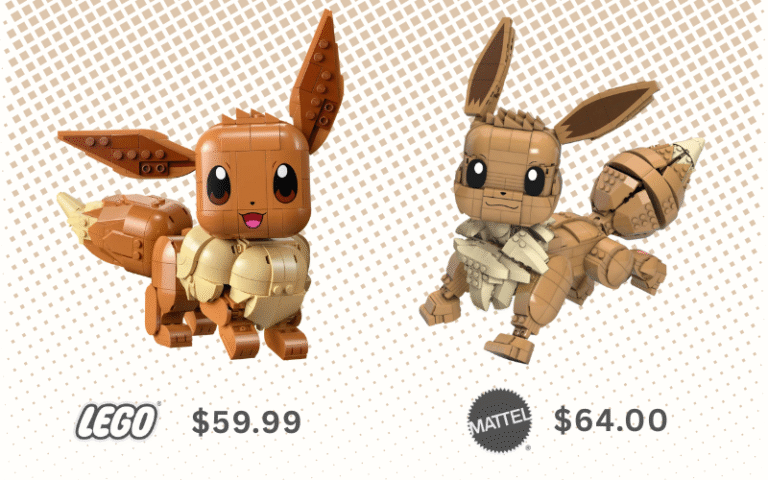
🟡 LEGO Eevee vs MEGA Eevee
Eevee is where LEGO gets closest to fully working for me.
Visually, LEGO’s Eevee looks right immediately. The layered fur detailing, subtle joint movement, and wagging tail give it a sense of life, and the face captures Eevee’s personality well. As a display piece, I think LEGO’s Eevee is cleaner and more polished than MEGA’s older Eevee build, which looks blockier and more toy-like.
However, MEGA’s Eevee felt more in line with what Pokémon usually is. It was smaller, simpler, and easier to own. It did not try to present itself as a premium centerpiece. It felt like something you could pose casually or add alongside other Pokémon without committing to a larger display setup.
LEGO’s Eevee sits at $59.99, while MEGA’s Eevee was around $64. When you compare the two purely as Pokémon sets, I think that LEGO’s Eevee comes out way ahead. It looks cleaner, more polished, and for roughly the same price, I definitely prefer LEGO’s take.
Where the problem really shows up for me is when I stop comparing LEGO Eevee to MEGA Eevee and start comparing LEGO Eevee to other LEGO sets. I have seen similar LEGO sets go for $25 to $30 while offering accessories, transformation options, or actual play features. Some of those are licensed sets as well.
While Eevee feels justified when viewed only within a buildable Pokémon lineup, it becomes much harder to justify within LEGO’s own lineup, especially considering its compact size and straightforward build at nearly $60. As a Pokémon set, the price makes sense. As a LEGO set, it does not.
I have gone into this in more detail in this article, where I give recommendations for the Eevee set and compare how it stacks up against other LEGO sets in the $20 to $30 range.
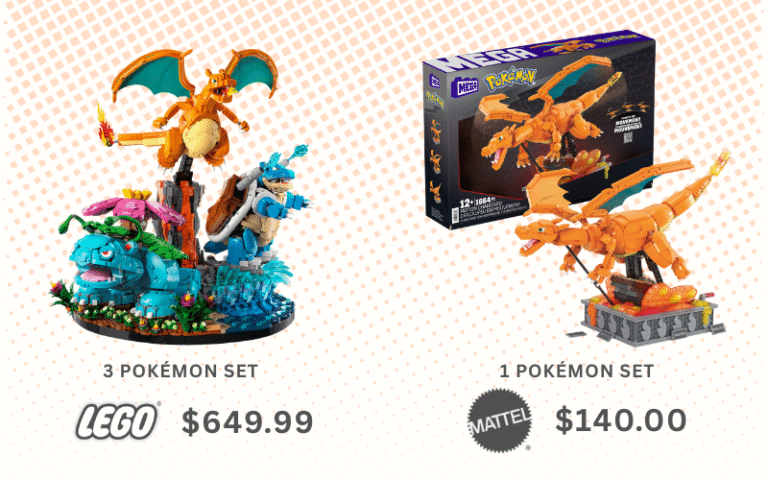
🟡 LEGO Charizard (& Starters Evolution) vs MEGA Charizard
This comparison is not as clean as Pikachu or Eevee, since LEGO’s Charizard is bundled together with Venusaur and Blastoise, while MEGA sold Charizard as a standalone set. Still, because both lineups include Charizard, it feels worth comparing how each company approached it.
Visually, LEGO’s Charizard looks exactly like what you would expect from a premium build. It is large, detailed, and clearly designed to be a centerpiece. MEGA’s Charizard, while smaller, felt more focused as a character build, with poseability and movement that made it feel like Charizard was mid-attack rather than flying statically. Overall, I rank them fairly close, but I would give LEGO the edge here for its color tones and more realistic shaping. It feels closer to the Charizard me and I’m sure most people recognize today.
Once again, the real issue is price and positioning. MEGA’s Charizard retailed at around $140. Even if you roughly apply that logic across all three Kanto starters, you would expect LEGO’s trio to land somewhere closer to the $300 to $400 range, especially considering bundle sets are often discounted. Instead, LEGO prices the set at $650, pushing it firmly into ultra-premium territory.
Charizard, Blastoise, and Venusaur are some of the most iconic Pokémon ever, and locking them behind a price point this high feels out of pocket with how accessible Pokémon has always been. LEGO made the builds bigger and more impressive, but in doing so, they narrowed the audience dramatically. It does not really embody the idea of “catch them all” when only a small group of fans can realistically afford to participate in obtaining them.
By contrast, MEGA offered these Kanto starters at multiple price points, from smaller and more affordable builds to higher-end display sets. Even if those versions were simpler, they gave fans options, which is something LEGO’s current Pokémon lineup is missing.
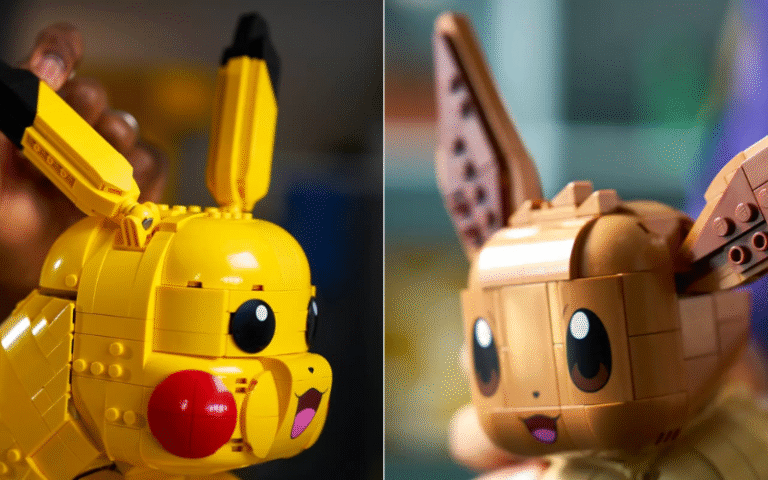
What the What These LEGO Pokémon Sets Reveal So Far
Looking at Pikachu, Eevee, and the Kanto starter evolutions side by side makes LEGO’s overall direction very clear to me.
When LEGO works with Pokémon whose shapes naturally translate to the brick system, the results can be genuinely impressive. Eevee is the best example of that so far. But when a design relies more heavily on soft curves, exaggerated motion, or expressive silhouettes, MEGA’s older builds still feel more playful and more aligned with what Pokémon has traditionally been about.
More importantly, these comparisons reveal a consistent pattern. Based on what LEGO has shown so far, LEGO Pokémon sets appear to prioritize premium display pieces over accessibility and variety. The focus has been on larger, statement builds rather than smaller sets that invite easier entry and wider collecting.
For me, that is where the disappointment really sets in. Pokémon became what it is because it was easy to jump into, easy to collect, and easy to play with. Right now, LEGO’s Pokémon lineup feels like it is speaking to a much narrower slice of that audience. The builds are impressive and the presentation is premium, but the entry point is high and the options are limited.
I do not think LEGO is incapable of doing Pokémon justice. I just think the line has started in the wrong place. If LEGO truly wants Pokémon to thrive in brick form, it needs to meet fans where Pokémon has always lived: in accessibility, variety, and play, not just on a display shelf.
I have already shared some ideas and recommendations on how LEGO could move in that direction toward the end of my LEGO Pokémon Eevee 72151 Set Preview article, for anyone who wants to explore that perspective further.